Council Delivers Nature-Based Mangrove Restoration at Lammermoor Beach
Published on 30 March 2026
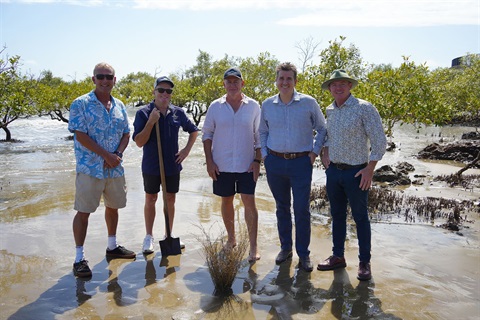
In an exciting first for Livingstone Shire, Council was pleased to commence an innovative mangrove restoration and shoreline stabilisation project along the Lammermoor Beach south foreshore today, as part of Council’s Natural Resource Management Program.
The trial project involves the installation of biodegradable sediment capture and seed recruitment devices within the intertidal foreshore zone.
Designed to work with natural coastal processes, the initiative will help reduce localised erosion, capture suspended sediments before they enter coastal waters, and encourage the natural recruitment of mangroves and associated intertidal vegetation.
Over time, this process will strengthen shoreline stability through nature-based mechanisms rather than engineered structures.
Assistance for the project is provided through the 2022-23 round of the Queensland Resilience and Risk Reduction Fund (QRRRF), jointly funded by the Australia and Queensland Governments, to help communities mitigate and manage the risks associated with natural disasters.
Federal Minister for Emergency Management, Kristy McBain, said the Albanese Government was proud to back practical projects that reduce risk and help communities better withstand disasters across the state.
“Nature-based solutions like mangrove restoration can stabilise shorelines, protect valuable coastal habitat and improve water quality—delivering real benefits for local residents and the environment,” Minister McBain said.
“We’re investing in initiatives that help manage erosion and reduce the impacts of future natural hazards identified and led by local governments like Livingstone Shire Council.”
Queensland Minister for Disaster Recovery Ann Leahy said the Crisafulli Government recognises the importance of investing in local projects that build resilience.
“This is exactly the kind of practical, locally led project the Queensland Resilience and Risk Reduction Fund is designed to support,” the Minister said.
“By investing in nature-based solutions and working in partnership with all three levels of government, we are helping communities reduce risk, protect their environment and be better prepared for future disaster events.”
Member for Keppel Nigel Hutton said this project is a great example of how the community is embracing practical, long-term solutions to protect the coastline.
“Lammermoor Beach is such an important part of our local lifestyle, and this project shows how we can work with nature to protect it for future generations,” Mr Hutton said.
“We are backing innovative, sustainable approaches that reduce erosion, strengthen our natural environment and deliver real benefits for the Keppel community.”
Livingstone Shire Mayor, Adam Belot, said the project represents a practical and science-led solution to coastal erosion.
“This project is about working with nature rather than against it, and Council is thrilled to be taking part in this new and important environmental initiative,” Mayor Belot said.
“We are installing biodegradable devices within the intertidal zone that will slow tidal flows at the bank interface, encourage suspended sediments to settle out naturally, and allow mangrove seeds already present in the system to take hold exactly where they are meant to. It’s a simple, low-impact solution that delivers long-term benefits.”
Local Mangroves project leader Stuart Thomson said the reason this approach works so well is because each river and estuarine system contains its own unique composition of mangrove species.
“Traditional restoration efforts often rely on commercially grown seedlings that may not match the natural species mix of a particular system, which can lead to low survival rates,” Mr Thomson said.
“This new approach avoids that problem entirely. Instead of introducing outside stock, these devices capture propagules that are already moving through the local tidal system.
“That means the same seeds that would naturally establish in this environment are able to germinate in the same soil and sand composition, and at the right time of year. It creates the perfect situation for successful establishment.”
Environment and Development Portfolio Co-Lead, Pat Eastwood, said the devices are designed as a true “set and forget” solution. They can be installed at any time of the year by a small team without heavy machinery.
“Over their lifespan, they will capture approximately three to four seasons’ worth of seed before gradually biodegrading, with no maintenance or removal required,” Cr Eastwood said.
“This methodology replicates a successful trial at the Mooloolah River, where 330 devices were installed within a five-metre by fifteen-metre footprint.”
Cr Eastwood said the results were significant.
“Within that relatively small area, the project achieved more than 50 naturally recruited mangroves, many of which are now over 1.5 metres in height,” he said.
“Around 30 tonnes of sediment were captured, there was no device loss — even during major flood events — and there was absolutely no maintenance required. That demonstrates just how resilient and effective this approach can be.”
Within three years, Council expects to see measurable sediment accretion, improved bank stabilisation, and natural mangrove recruitment across the installation footprint.
Sediment export into nearshore marine waters is anticipated to decline, while ecological function within the intertidal zone is expected to improve.
Mayor Belot said the broader benefits extend beyond shoreline stability.
“By reducing sediment runoff, we are helping protect nearshore marine environments and supporting reef health through reduced turbidity,” he said.
“This project strengthens intertidal habitat for crabs, worms and estuarine species, while providing a cost-effective and scalable model for coastal resilience across Livingstone Shire.”